Plan application availability with your administrator
Deployment describes how the platform runs. A small installation can use one Inflow instance. A larger installation can run several active API instances and background workers. The API instances answer user requests; workers perform the background responsibilities assigned to them.
The platform administrator designs and operates that arrangement. A consultant's role is to explain the application's needs and check the resulting user experience. Adding a second workspace is not the same thing as adding another running server.
Separate server deployment from application release targets
Inflow has three related but distinct administrator concerns. Keep them separate in a deployment request:
| Concern | What Inflow provides | What the administrator still owns |
|---|---|---|
| Application delivery targets | The Deployment area can describe destination environments such as development, test, UAT, staging and production, with push, pull or offline transfer modes. | These labels describe where application releases are intended to go. They do not install an Inflow server, provision a cluster, select a database failover mode or certify a topology. |
| Inflow process roles and node operations | A running Inflow node can publish its identity, region/zone, roles, heartbeat and status. Operators can inspect node/worker status and request a drain or resume for a specific node. | The process manager or orchestrator, stable unique node IDs, node-specific role/configuration, network routes, shared dependencies, capacity, upgrades and recovery plan. |
| Infrastructure deployment and resilience | Inflow supplies application behavior that runs within the configured node and dependency boundary. | Hosts or containers, load balancers, database and broker availability, identity/session storage, document storage, backup/restore, regional replication, secrets, monitoring and the authorized failure exercises. |
The current Deployment UI is therefore not a general-purpose server-cluster builder. A production environment row named “Active-active” would still be only an environment label; it would not create or validate active API nodes, worker placement, load balancing or database replication. Likewise, a script maintained by an operator can provision infrastructure, but it should be presented as that operator's deployment automation unless it is an Inflow-supported customer CLI with a documented contract.
Keep application releases and server-topology automation as separate operator handoffs. The administrator automation guide describes which release steps have a documented Studio or HTTP route, which operations do not add up to a full release CLI, and what an internal wrapper must report. For example, an approved process that prepares and inspects a signed People Operations package is still a workspace-release process; an operator's automation that assigns unique API/worker node identities and roles is infrastructure work. One does not prove the other happened. Record their approvals and results separately, and verify the business journey through the normal application address after any admitted release or infrastructure change.
Recognize the release setting in the actual interface
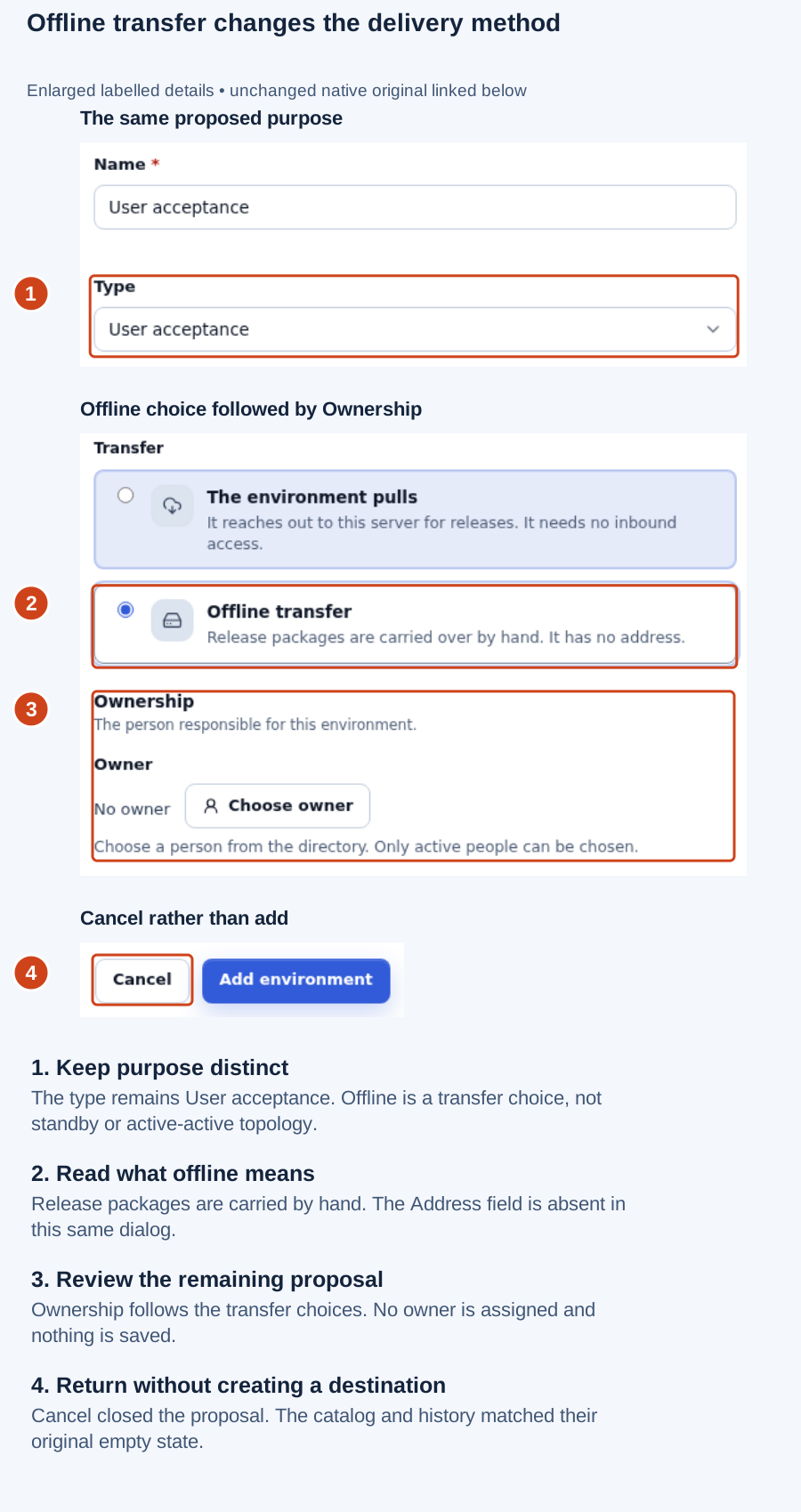
Administrator preparation, 18 November 2026: the proposed type is User acceptance and Offline transfer is selected. The Address field is absent. This form was cancelled; no destination or infrastructure was created. The numbered guide enlarges labelled details from the same screenshot. Open the original screenshot.
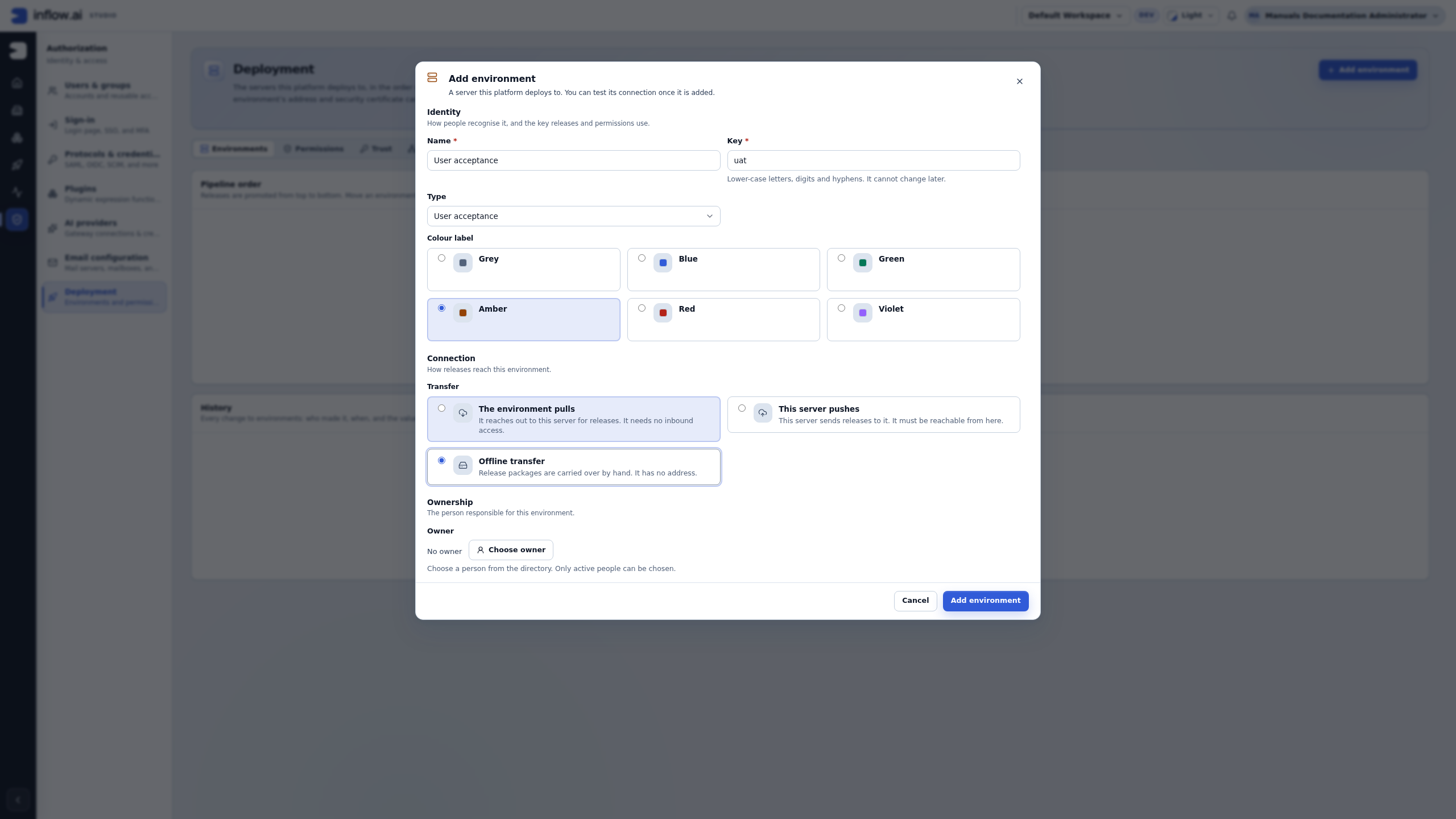
Read these controls as two different choices: Type describes the receiving environment’s purpose, while Transfer describes how release packages reach it. Neither control selects API node count, a standby site, database replication or a regional failover design. In this practice the same UAT proposal changes from pull transfer to offline transfer without changing its purpose. The operator brief below is still needed to define availability.
Visual map: application release and server topology are separate lanes
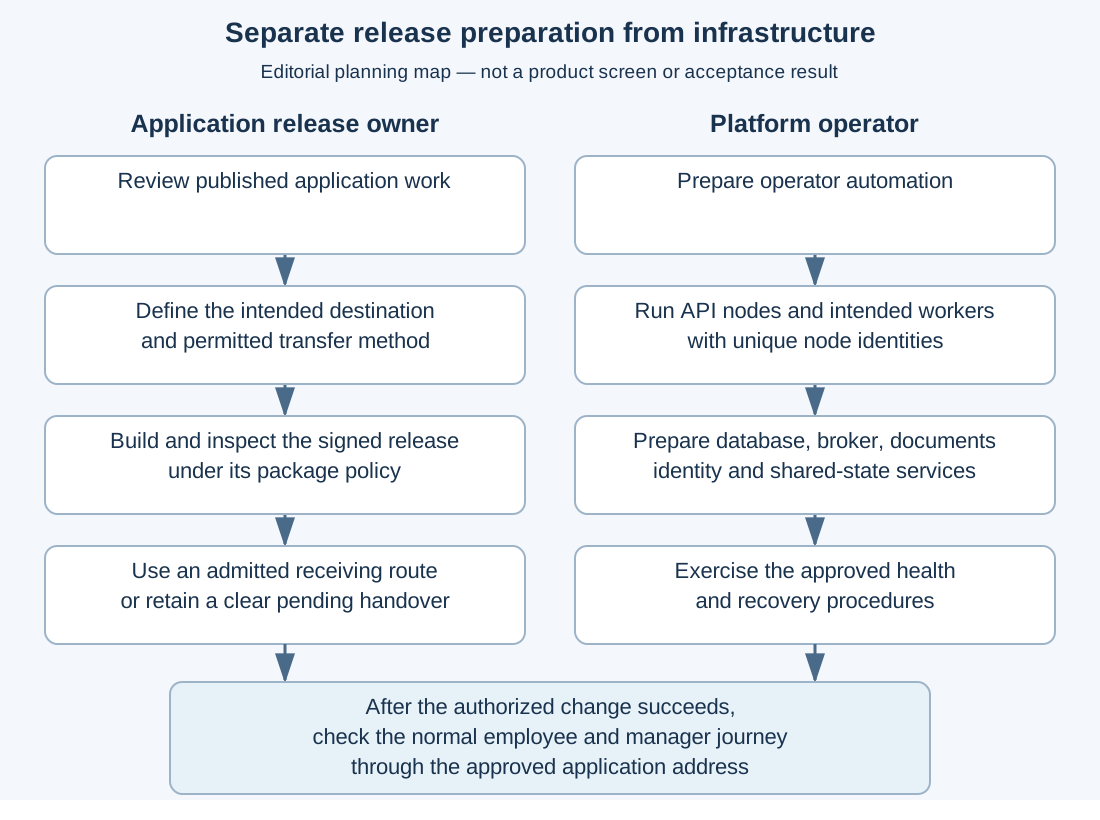
How to read this map: the left lane moves a reviewed application package between workspace environments. The right lane describes how an operator runs the Inflow service and its dependencies. Inflow's environment record does not provision the right lane; an operator's scripts do not automatically perform the left lane. The drawing is a planning schematic based on documented responsibilities, not a screenshot, turnkey topology, or proof of high availability. The administrator must validate every dependency and failure case for the target build.
For an Inflow node topology, the source documents INFLOW_NODE_ID, INFLOW_NODE_ROLES, INFLOW_NODE_REGION and INFLOW_NODE_ZONE, plus the canonical platform.worker.autoStart setting. The supported node API exposes current and active node state, worker state, and ID-addressed drain/resume operations. Those are controls over an already-running Inflow deployment; they are not an installer, orchestration API or full application-release rollout CLI. See the administrator node reference for the source-qualified settings, routes, authorization and operational limits.
When the administrator describes the roles, ask two separate questions: which work can this node claim, and is its worker loop actually configured to start? A configured role makes a phase eligible; it does not prove that the phase is running or that its broker, database, module and provider dependencies are ready. For example, a node configured only as api does not become a timer worker because the API is healthy. The specialist reference lists each current role and the worker phases it selects.
Before selecting a deployment pattern, ask the administrator to identify which parts are supplied by Inflow, which come from the operator's infrastructure, and which have been exercised in the exact environment. Do not call the whole installation active-active just because one of those layers has multiple instances.
What to prepare with the specialist
- Explain the business hours, important workflows and expected number of users to the platform owner.
- Identify the effects of an interruption: can employees wait, or must urgent tasks remain available?
- Ask the owner to describe the intended Inflow capacity and the availability of its database, messaging and document services separately.
- Agree maintenance arrangements and the user journeys to check after an approved change.
- After the owner confirms the environment is ready, check the actual employee and manager experience through the normal application address.
Compare deployment patterns by the failure they must survive
Use deployment names to start a conversation, not as evidence that a particular Inflow installation is supported or tested. The technical reference describes multiple API and worker nodes, but the administrator must confirm the exact build, node roles, shared services and operating procedure for the target environment.
| Pattern to discuss | What it changes | Evidence to ask the operator for | What the label alone does not prove |
|---|---|---|---|
| One Inflow instance | The API and any enabled background responsibilities run in one installation. | A documented backup and recovery path for the instance and its database, broker, document storage and external dependencies. | Redundancy or continued service when that instance or a shared dependency fails. |
| Multiple active API nodes | More than one API node can serve requests behind the approved route. | Distinct node identities, intended API/worker roles, load-balancer health behavior, durable shared-state design and evidence that the same user journey works through the normal address. | Database failover, global multi-region writes, or safe background processing merely because two nodes answer HTTP. |
| Separate API and worker nodes | HTTP service and selected queue responsibilities run on separately identified nodes. | The required worker roles, each worker's canonical start setting, broker reachability, queue ownership/lease behavior and user-visible completion evidence. | That a heartbeat means the intended queue is being processed or that an external side effect completed. |
| Standby or disaster-recovery site | An operator prepares a second site for a planned or emergency recovery path. | The recovery owner, data replication and restore steps, expected recovery time/data loss, routing change, dependency readiness and a separately authorized exercise result. | Automatic failover or zero data loss. Those are operator-defined outcomes that need their own proof. |
| Multi-region active-active | Users may be routed to active services in more than one region. | An explicit design for database writes, broker delivery, identity/session state, files, conflict behavior, regional failure and duplicate-work prevention, plus the authorized cross-region acceptance results. | That Inflow provides independent writable regional clusters, conflict-free records, or transparent database failover by default. |
If the team asks for “active-active,” ask which layers are active: API, workflow workers, database, message broker and document service. Record each layer's owner and recovery behavior. “Two API nodes are healthy” is narrower evidence than “the leave approval service survives loss of a region.”
Turn an availability request into an operator brief
Before anyone selects a topology, write down the failure the business wants to survive. “More capacity,” “the service must stay open during a node restart,” and “staff in another region must continue after a regional outage” describe different outcomes. Do not choose a deployment label first and try to make the requirement fit it later.
Use this worksheet with the platform owner:
| Question | Record | Why it changes the design |
|---|---|---|
| Which user-visible journey must continue? | Name the normal application page, record action, manager task or document outcome. | A healthy status page can coexist with a broken business journey. |
| What exact failure should it survive? | One API process, a worker, a host, a database, a broker, a document service, a site or a region. | Adding API nodes addresses a narrower failure than losing a shared database or site. |
| Which services are shared? | Database, broker, identity/session store, document storage and external providers; name each owner. | Any single shared dependency may still stop the journey. |
| What is allowed to pause? | Identify background work that may wait and the work that must be available to users. | API and worker placement can differ; a worker role alone does not prove execution. |
| How will recovery be authorized and observed? | Name the change owner, decision authority, recovery steps and evidence to retain. | A routing change or restarted process needs an accountable operator and a real result. |
| What outcome is acceptable? | Have the business owner set recovery-time and data-loss expectations with the operator. | “High availability” is not a measurable acceptance result by itself. |
Then classify the request provisionally:
- If the need is to serve more concurrent requests, ask whether multiple API nodes behind the approved route address that load. Check the database and all shared dependencies separately.
- If HTTP capacity and background processing need separate sizing or maintenance, ask the operator to describe distinct API and worker roles, queue ownership and the user-visible completion check.
- If the need is to continue after a process or host loss, ask what restarts or takes over, which dependencies remain available, and which already-running work can be retried or reconciled.
- If the need is recovery after a site or region loss, request the approved recovery design and an authorized exercise. A second site in a diagram is not evidence that it can take over.
- If the request requires independent writable regions, ask the platform owner to validate database consistency, duplicate-work prevention, identity/session behavior, files and provider effects together. Do not infer that capability from multiple API nodes or an “active-active” label.
This classification is a planning aid, not a platform certification. The deployment owner must compare the exact Inflow build and dependencies with the requested failure case before promising availability.
Give the owner a compact handoff instead of a topology label:
Business journey: employee submits a leave request; manager reviews it
Failure to survive: one API process restart
In scope: API nodes and the approved request route
Still shared: database, broker, identity/session state, document service
Background work allowed to wait: nightly report generation
Recovery owner and action: platform operations, using the approved node procedure
Owner-agreed limit: record the permitted interruption and data-loss bounds before the exercise
Acceptance check: during the approved restart window, use the normal route to submit one permitted test request and decide only its explicitly owner-approved synthetic test task; record timestamps and observed results
Uncertain result: inspect the original request/task and its status before any retry; never create a second request just to test whether the first one completed
Not established by this check: database failover, site recovery, regional writes
Agree how measured interruption and any accepted data-loss observation will be compared with the owner's bounds. For a different requirement, replace the failure and acceptance check; do not reuse this handoff as evidence for another layer. If a dependency owner cannot provide its part of the plan, mark that layer unresolved and keep the business availability claim bounded to the evidence already available.
Example: “active-active” can mean two different requests
People Operations has 1,500 employees and sees slow page loads at month-end. The first request is “make Inflow active-active.” Nadia asks which failure matters. The immediate problem is concurrent request capacity; the operator proposes two API nodes behind the current approved route, with one shared database, broker and document service. The worksheet records this as API capacity with shared dependencies. It does not describe a database failover or regional recovery design. Nadia and the operator agree to check the normal employee request and manager decision through the usual address while separately observing the shared services.
In a different review, the business says staff must keep submitting leave requests after a regional outage. The same two API nodes do not answer that request: both could depend on services in the unavailable region. The owner must identify where data, broker state, identity/session state, documents and provider connections are recovered, who authorizes traffic movement, and which request/task outcomes are checked after recovery. Until that specific exercise has an accepted result, Nadia records regional continuity as planned, not verified.
Do not let the first design silently become evidence for the second. Keep each claim tied to the failure it actually addresses and the exact journey tested.
Example: distinguish API capacity from end-to-end availability
The People Operations application needs its employee form and Sara's manager task during business hours. The operator proposes two API nodes but one database, one broker cluster and one shared document service. Nadia records this as an API-scale design with shared dependencies. She asks what users see if the database or broker is unavailable and who restores the affected service. She does not describe the design as multi-region resilient without the corresponding dependency and failure evidence.
Example: ask for bounded recovery evidence
The business owner asks whether an alternate site can take over after a regional outage. Nadia asks the platform administrator to state the recovery objective, data-replication point, activation authority and the exact user journeys already exercised. Until the authorized exercise exists, the handoff records disaster recovery as planned or not verified. A diagram or a successful login before failover is not the outage test.
Example: prepare a clear business check
The leave application has a planned maintenance window. Nadia tells the administrator which forms, requests and manager tasks matter most. The administrator determines whether the platform has enough remaining capacity for an approved rolling update.
Nadia checks normal login, the employee form and a permitted manager task after the change. She does not claim high availability merely because two browser tabs opened. That requires the operator's separate infrastructure and failure testing.
Example: keep the responsibilities separate
A team requests active-active service for a more critical application. Several active Inflow instances can share the intended durable services, but a single failing database or file service could still interrupt business work.
Nadia therefore asks for a complete availability plan, including those dependencies and recovery responsibilities. She does not promise independently writable multi-region operation or automatic database failover from a region label. The technical companion gives the operator the actual node roles, readiness and safe maintenance controls.
If the result is not clear
Keep the original result and explain what is missing. Ask the responsible owner to investigate before repeating an uncertain action or widening access. A missing control is not an instruction to use somebody else's account.
Continue with the consultant guides
Read understand the application building blocks and release application content. The specialist reference below contains the detailed setup; it is not ordinary consultant preparation.
Further reading
Optional technical reference — detailed contracts and implementation information for your administrator or developer. You do not need it to follow this lesson.